
Plug-in Solar Panels Can Expand Access to Affordable, Renewable Energy
May 27, 2026
Overview
In the face of rising energy costs and a strained electrical grid, policy-makers are eager for strategies to lower the energy burden for their constituents, including both homeowners and renters. Increasing access to plug-in (or balcony) solar by passing laws that address barriers to their use has become increasingly common in states across the U.S.
The power grid in the United States is under strain. Energy demand is rising, due to everything from longer and hotter periods of extreme heat to the explosive growth of data centers, while infrastructure to generate, transmit, and distribute electricity ages and becomes increasingly vulnerable to outages and blackouts. Meanwhile, rising energy prices are contributing to economic instability for many families. Low-income, Black, and Hispanic households bear a higher energy burden, meaning on average they spend a greater portion of their income on meeting energy needs.
Compelling evidence demonstrates that the adverse health effects of extreme heat fall disproportionately on Black and Hispanic households, and people of color more broadly. People experiencing energy insecurity may be forced to choose between paying their energy bill, or paying for other basic needs such as rent, food, and medicine. Or they may try to limit their household’s energy use by keeping air conditioning turned off, or by using alternative heating strategies, such as space heaters or ovens. These efforts to limit energy consumption may cause discomfort, lead to lower sleep quality, or result in much more severe health consequences, including death. In addition, fossil fuel combustion is a principal contributor to both air pollution and extreme weather, which result in adverse effects on respiratory health, among other health impacts.
In the face of rising energy costs, policy-makers are eager for strategies to lower the energy burden for their constituents, including both homeowners and renters. As one path to address these concerns, in 2025, Utah passed a first-in-the-nation law addressing barriers to plug-in solar, also known as balcony solar. This year, several other states (including Colorado, Maine, Maryland, and Virginia) have passed similar laws, with bills introduced in numerous other states. Plug-in solar is already common in Germany, where it is called balkonkraftwerk, for the apartment balconies where it is frequently deployed in arrays of one or two panels.
What is Plug-in Solar?
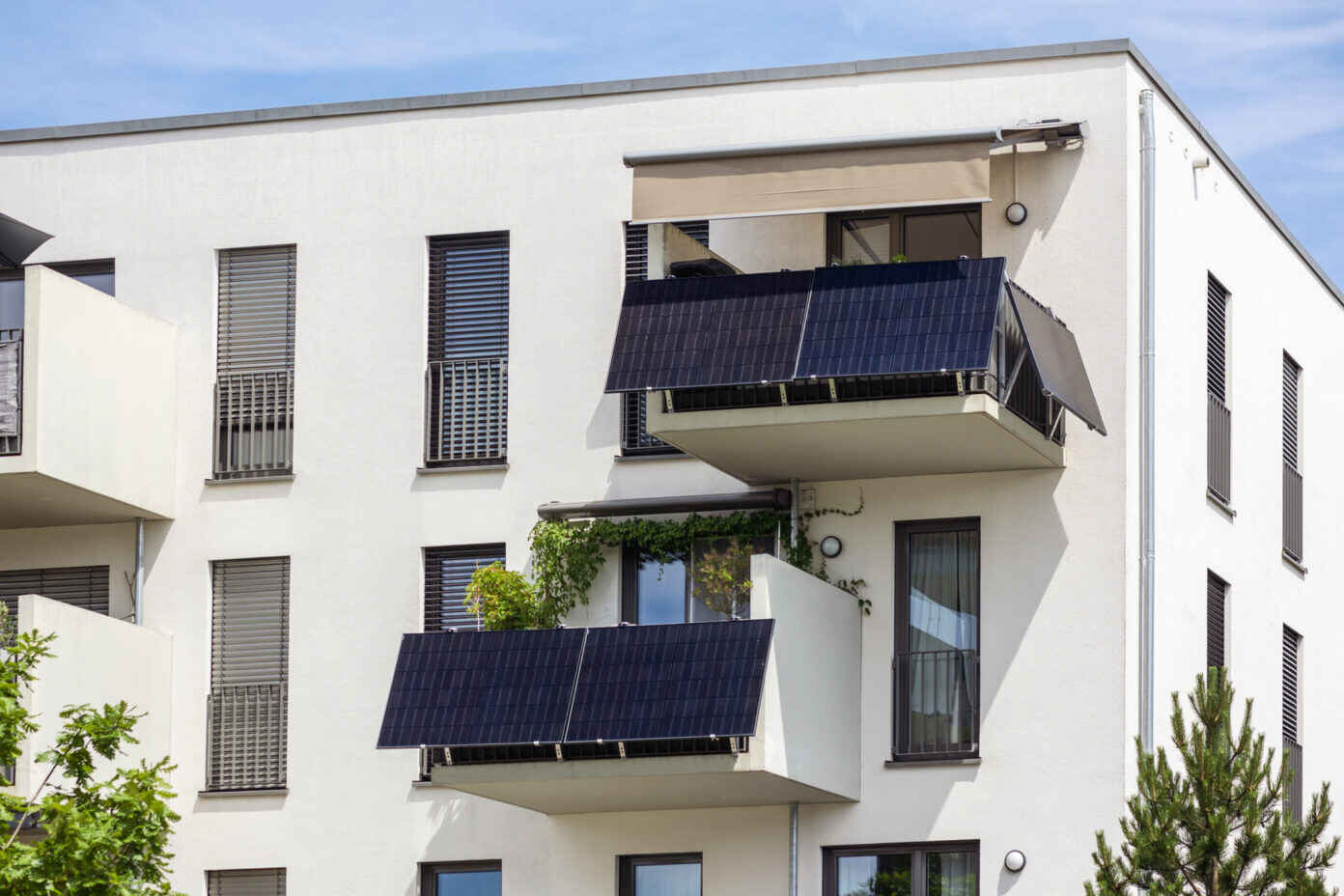
“Plug-in solar,” also called balcony solar, refers to solar panels that can be plugged into a standard electrical outlet in order to generate renewable energy. Because plug-in solar typically consists of small arrays, the initial investment required is lower and may be recouped faster than with a rooftop array. Plug-in solar panels currently cost anywhere from $500 to $1500 and can save from $200 to $800 in energy bills per year for a small 1200-watt system. For reference, 1200 watts is generally enough to power appliance such as hair dryers, microwaves, and refrigerators. An average rooftop system in the U.S. is about 7 kilowatts and meets a much greater proportion of a household’s needs, but has a correspondingly larger cost. The relatively lower cost of plug-in solar is still prohibitive for many people. At least one nonprofit organization is currently marshalling funds to provide discounted and free plug-in solar for households where cost is a barrier.
The spaces where plug-in solar can be installed are not limited to rooftops, but include balconies, patios, decks, and backyards. This means plug-in solar panels can be used by many renters. Homeowners facing the elimination of federal rooftop solar tax credits may also have heightened interest.
Utah’s Law Eased Administrative Burdens and Catalyzed Action on Safety
States face legal, technical, and practical barriers to widespread adoption of plug-in solar, including the following: interconnection agreements with utilities, safety concerns, permitting requirements, costs and accessibility, and security and theft prevention. Utah’s law addressed two important challenges.
Interconnection Agreements
In general, when a person or household signs up for utility services and becomes a ratepayer, they agree to disclose any changes in electrical load or energy resources. Additionally, if new energy resources, such as solar panels, have the potential to produce excess energy beyond the needs of the household which would be exported to the grid, the ratepayer usually needs to enter into an interconnection agreement with the utility. An interconnection agreement sets forth the terms and conditions by which the ratepayer will sell energy back to the utility. However, the relatively small capacity of plug-in solar means that the likelihood of net excess energy being produced over time is low. Accordingly, Utah’s law exempts “portable solar generation devices” as defined in the statute (including a maximum power output of 1200 watts) from interconnection requirements. This exemption lowers administrative delays and costs to install plug-in solar panels.
Safety
The Utah law took an interesting approach to safety for this emerging technology. Rather than setting forth its own safety standards, it defined a “portable solar generation device” as one that “meets the standards of the most recent version of the National Electrical Code” and “is certified by Underwriters Laboratories or an equivalent nationally recognized testing laboratory.” Now, this kind of “incorporation by reference” of standards that are set forth elsewhere in the law or in standards administered by a third party entity is relatively common. What is somewhat unusual is that Underwriters Laboratories, or UL, did not have certification standards at the time that Utah passed the law. Utah’s legislature did not have authority to direct Underwriters Laboratories to adopt certification standards for plug-in solar, but in this way, they “forced” the issue, and UL chose to develop a framework for testing and certification of plug-in solar, UL 3700, following passage of the law. The Clean Energy States Alliance has produced a guidebook on What States Need to Know About Plug-in Solar, including safety.
Plug-in Solar Can Lower Energy Bills and Expand Access to Clean Energy for Renters
All of the factors named above – the relatively lower cost, the accessibility to renters, and the reduced fossil fuel consumption – mean that plug-in solar could contribute to health equity if adopted at scale. Expanding access to apartment-dwellers and renters is significant, because financial circumstances and prior legal interventions to promote solar adoption have generally aligned to advantage more affluent homeowners, as with the production tax credit for installing rooftop arrays. Expanding access for renters is likely to reduce racial disparities. Over 50 percent of households led by African American and Hispanic people are renters, while fewer than 30 percent of households led by white people are renters. Easy installation could also be a boon in terms of accessibility for renters.
Passing state laws to facilitate wider adoption of plug-in solar is anticipated to make a modest, but meaningful, contribution toward lowering energy burden and increasing energy independence for individual renters and homeowners. It is also expected to make a modest, but meaningful, contribution to lower emissions of carbon and particulate matter and to alleviate some strain on the grid, lowering the risk of health-harming pollution and power outages for whole communities. As long as energy costs continue to rise, plug-in solar laws and technology are likely to continue to evolve in order to expand access to affordable renewable energy.
This post was written by Jill Krueger, Director, Climate and Health, Network for Public Health Law.
The Network promotes public health and health equity through non-partisan educational resources and technical assistance. These materials provided are provided solely for educational purposes and do not constitute legal advice. The Network’s provision of these materials does not create an attorney-client relationship with you or any other person and is subject to the Network’s Disclaimer. Support for the Network is provided by the Robert Wood Johnson Foundation (RWJF). The views expressed in this post do not represent the views of (and should not be attributed to) RWJF.